

In his novel 1984, George Orwell imagines a political regime that imposes its authority in part through language. Newspeak, the official language, is designed to reduce and control vocabulary and reflects the desire of the ruling power to limit its subjects’ ability to think. By restricting citizens’ capacity for language, by raising up certain words and trampling others underfoot, the Oceania dictatorship ultimately seeks to weaken people’s ability to reason and to think critically.
We’ve long understood the importance of words (“In the beginning was the word…”). It’s no coincidence that what fascinates (and/or unsetlles) us about AI today is that, until now, we walked this earth confident in the fact we were the only ones who could play with words, the only ones posessing the power we must now share with machines that have developped the capacity to statistically predict which word will come next—and the one after that—to form fully fledged sentences that look uncannily like ones a humans might make.
Every day at The École, we do everything we can to ensure our students understand the importance and the power of language—it’s in our DNA as a bilingual school. We teach them to treat each word as a gift that widens the doors to knowledge and to the world. We teach them that words are infinitely precious, treasures to be cherished, not by keeping them locked away but by breathing life into them.
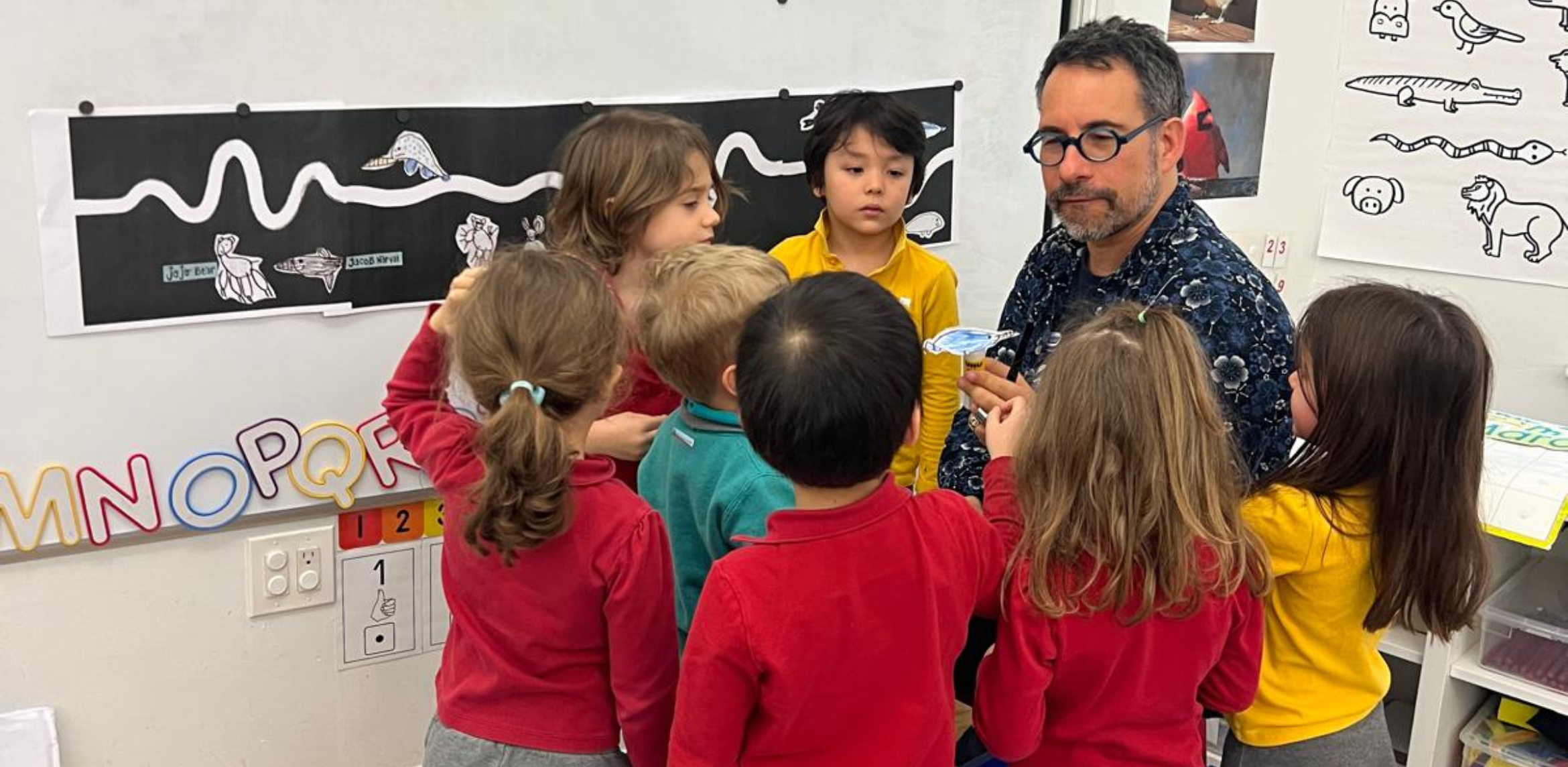
In that respect, this past week has been exceptional. Five authors and an illustrator visited the school and led workshops across grade levels, working with words, as part of the Children’s Literature Festival, and two slam poets have spent the week, as has become tradition, with our 5th graders. We played a lot with words this week in the classrooms: small words that snap, long words we don’t know how to spell, words that make us laugh, words that scare us, words that seem lost on their own, false friends that look the same but mean very different things in French and in English, words we know but don’t dare utter in front of grown-ups, severe words, gentle worlds, outdated words, invented words, portmanteau words.
When we string them together, these words tell stories that can be joyful, daft, dark, scary, mysterious, and touching. Stories we make up, we read, and illustrate—it’s been magical to follow Régis’s confident line as he draws inspiration from the words of others and conjures up so wonderfully what we read. We marvelled all week long at our visitors’ talents, and we rediscovered that from everyday words we can make things so beautiful that they stay with us.
A heartfelt thank you to Sophie Werth, Maya Korenbeusser, and Camille Martin for making this week possible and for your impeccable organization. And, of course, thanks to Brice, Cécile, Régis, Sébastien, Sophie E., Thomas, Victor, and Yehudi, who came to spend time in our classrooms helping our students understand that playing with language, telling a story, letting their pen flow freely, and putting words to music are essential acts of freedom—a thorn in the side of those who want, or in the future would like, us to believe that we don’t need to think.